AFTER SCHOOL + SUMMER PROGRAMS
I have taught art lessons to children in Portland-area camps and after school programs, including Waynflete, East End Community School, and Brown Elementary.
I have taught art lessons to children in Portland-area camps and after school programs, including Waynflete, East End Community School, and Brown Elementary.
When possible, I like to take advantage of interdisciplinary opportunities because I believe that true understanding comes from transferring learnings to new situations. When I heard the LearningWorks students in the summer program at East End Elementary were beginning a curriculum on the Olympics, I decided to embrace that theme with a medal-making project. I introduced the rising 4th and 5th graders to Junichi Kawanishi, the medal artist for the Tokyo Games, and gave them a brief history of the craft and the markings still required on Olympic medals today. Using clay and paint, the students created their own medals that celebrated something they loved or felt good about. Some depicted trucks, favorite sports, or family members. Another included a medley of colors to express “all the parts of me,” the artist explained.


At Centerpoint Martial Arts, my co-teachers and I taught a group of early elementary students a two-day lesson on color. We wanted to introduce the notions of primary and secondary colors in an age-appropriate way that would capture their attention and reinforce the concepts.
The first day we introduced the color wheel and had the students separate pieces of paper and fabric by color. Then they took the pieces and worked together to make a rainbow collage. The collaboration fostered teamwork and problem solving. Afterward we talked about the rainbow and how it represented the primary and secondary colors.
The second day we reinforced the lesson by having the students create secondary colors by mixing primary colors together using play-dough. Once the students had completed their color wheel, they made fun creatures out of the mixed dough, making sure to use both primary and secondary colors. Our closing activity was taking turns introducing our creature and saying what kind of colors we used to build it.
Every child was able to successfully label their colors and recount which colors had been mixed together to make new ones. The lesson used tactile materials to engage, short activities to hold interest, and scaffolded projects to reinforce learning.
WAYNFLETE HOT AIR BALLOONS


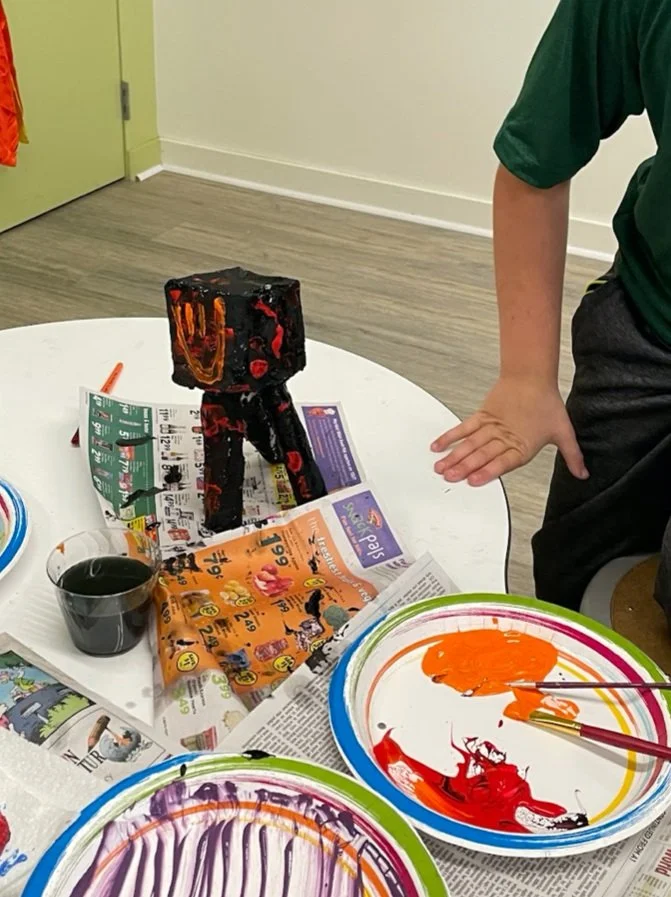
In our three-day lesson at Waynflete, my co-teacher and I introduced Alebrijes, the brightly colored Mexican folk art sculptures. We helped our students brainstorm ideas for incorporating elements of earth, air, water, and fire into their imaginary animals. But from that point on, we let them create with very little intervention from us. One student explored different approaches in the building stage and used the materials in ways we hadn't even considered. Another student created squares out of cardboard, which took him more time but thoroughly engaged him. In fact, he seemed to gain more from the experience than his peers by finding his own solutions; he was very proud of his work, and I'm glad we did not steer him to take the easier, more conventional path. The final pieces were full of color and personality, each one very unique to the artist.




At Brown Elementary After School program, my co-teachers and I taught a lesson on paper collage. After introducing the technique and sharing examples, we did not provide any parameters other than to "paint with paper." The open approach to the lesson allowed the students to dive into their own interests. The older girls made food items, such as donuts and ice cream cones. A couple of third-grade boys made the Pikachu character. The younger kids created landscapes. One girl made a flag on a mountain. The student-directed aspect of this lesson was particularly effective for this multi-age class, where interests and skill levels were vast and varied.
My co-teachers and I also did a mural project with the students at Brown. They used markers, crayons and pastels to create scenes representing the four seasons. We began by talking about what items make us think of spring, summer, fall and winter. Then we divided into four groups and played musical tables, moving in teams to each of the season stations so that all students contributed to all panels. The students loved seeing the panels displayed together and how their individual contributions were critical to the success of the overall piece.


On our final day at Brown, we led a creative monster lesson based on primary colors. We started the lesson by playing a drawing game in which I chose random attributes out of a jar — such as “three eyes” or “large feet” – and the kids had two minutes to draw creatures with those items. This was a perfect warm up for the sculpture project of the day in which they built monsters out of dough. Each student was given pieces in primary colors and were encouraged to mix colors as desired. At the end of class they shared their art with each other, as well as their monster’s name and back story.
